
Open Eastmont's VoteWA Lookup
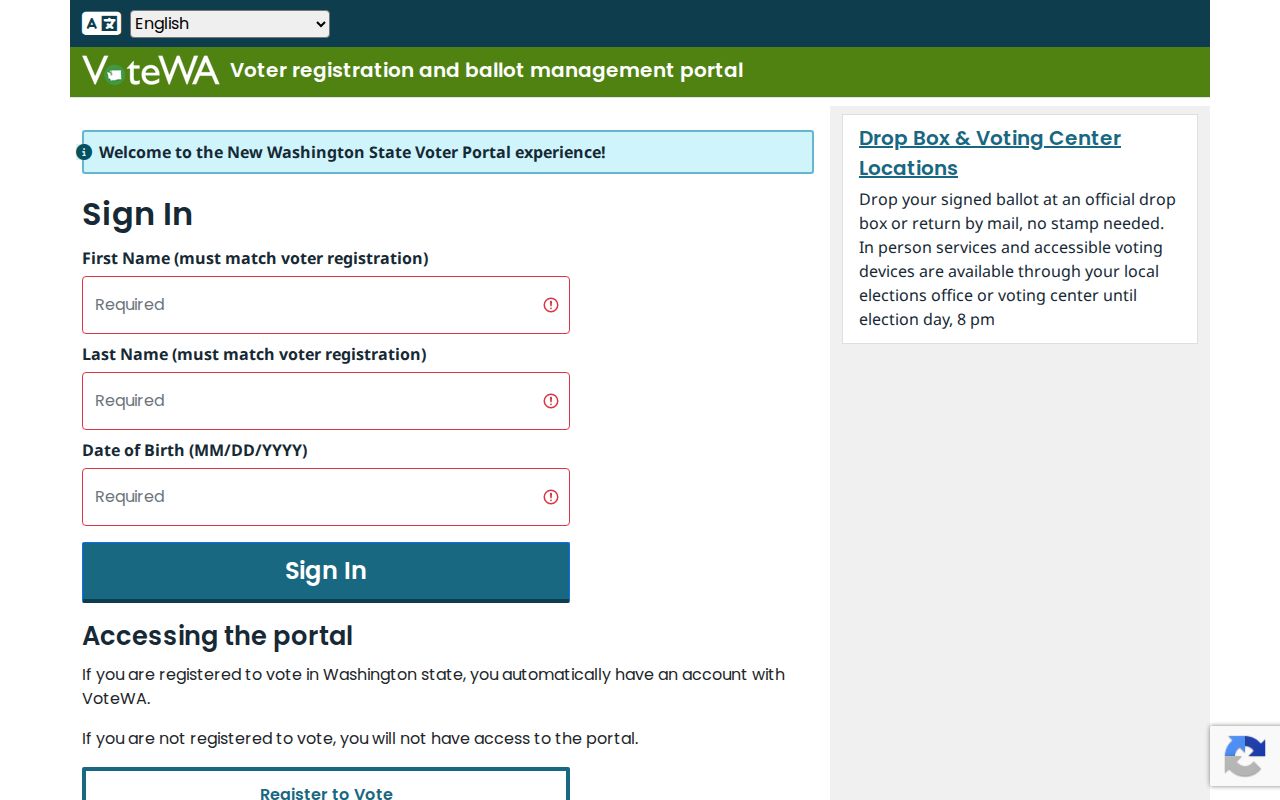
VoteWA is Washington's official self-service voter registration portal. It is for a voter checking or updating that voter's own record, not for browsing Eastmont residents by surname. Enter the identity details exactly as they appear on the registration. A match can open registration status, registered address information, Snohomish County, precinct and political districts, current election details, ballot status, voting centers, drop boxes, and participation history.
| VoteWA field | Control | Required | How to enter it |
|---|---|---|---|
| First Name | Text | Yes | Registered first name |
| Last Name | Text | Yes | Registered last name |
| Date of Birth | Date | Yes | Month, day, and year for identity matching |
| Login | Button | Yes | Opens the voter's record when details match |
| Register or Update | Link | No | Starts a separate registration workflow |
A failed sign-in proves only that the submitted facts did not match. Check spelling, a former name, the birth date, and any recent county or address change. Snohomish County Elections can then help resolve the record. VoteWA also offers the route to register or update an existing voter record.
The official VoteWA screen shows the three identity fields used for this Eastmont voter registration check.
The screen's full birth-date request is an authentication step. It does not make the full date public in a voter-file release.
Eastmont Voter Lookup Boundaries
VoteWA and a public voter list serve different tasks. The portal uses exact personal facts so a voter can reach a private profile. The statutory list exposes only a defined set of fields and carries strict limits on use. That split prevents an ordinary name search from becoming an unrestricted view of each resident's registration account.
VoteWA is not a public name directory. Use it for your own registration; request eligible data through the official election-record channels.
Once signed in, a voter may see precinct and district assignments, election notices, and ballot-credit details. Ballot credit means that an election record shows participation. It never reveals the candidates, measures, or choices marked on a secret ballot.
Note: A portal mismatch is not proof that someone never registered or is not eligible to vote.
Washington Voter Records by Field
RCW 29A.08.710 sets an exclusive public subset for Washington voter records. It permits disclosure of identification and election-administration fields while shielding the source form and sensitive identifiers. Washington does not register voters by party, so a standing party-affiliation field should not be expected. A presidential-primary declaration is election-specific and is not permanent party registration.
| Name | Public |
|---|---|
| Residence address | Ordinarily public, except protected voters |
| Political jurisdiction | Public, including relevant district or precinct jurisdiction |
| Gender | Public statutory field |
| Year of birth | Public; the full birth date is withheld |
| Voting record | Participation only, never ballot choices |
| Registration date and number | Public |
| Status | Active, inactive, or primary-only status may appear in the extract |
These fields can establish that a name was tied to an Eastmont-area address or precinct at a given point. They should be read as election records, not as proof of present occupancy. Address changes and list-maintenance events can alter what appears in a later monthly file.
Private Eastmont Voter Information
The original registration form is confidential. So are the signature, full date of birth, driver-license or state-ID digits, Social Security number digits, and phone or email fields outside the public subset. Information for voters under eighteen is separately restricted under RCW 29A.08.725. Ballot-envelope signatures and contact details also receive special protection.
Confidential under Washington law. RCW 29A.08.710 excludes the original form and sensitive identifiers; RCW 40.24.060 shields an Address Confidentiality Program participant's true address.
The Address Confidentiality Program provides a substitute-address system for eligible survivors and other protected people. Their actual residence stays outside ordinary disclosure. Elections staff use a special registration process so participation does not expose the protected location.
Request Washington's Voter File
The Washington voter database extract request is the main route for a statewide or selected-county active-voter file. Since March 25, 2026, state law centralizes statewide voter database records and reports at the Secretary of State. Snohomish County directs those database requests to the state, while its elections office still holds local records that it creates and maintains.
- Provide requester name, address, email, phone, and the requested geography. Select Snohomish County for the county file.
- Choose the data product and certify a lawful purpose under RCW 29A.08.720 and .740.
- Submit the electronic form. A valid email receives the download link, and the agency notes that requests can take up to five business days.
- Open the ZIP-compressed, vertical-bar-delimited file with its field reference. Commas may occur inside values, which is why the separator matters.
The active extract is refreshed near the start of each month, generally by the end of the first business day. The page posts no fixed price. Washington law permits actual reproduction costs, so no per-voter fee should be assumed. A delivered link may be time-limited.
Eastmont's 33-Field Voter Extract
The standard database has 33 public fields. They cover voter ID, name parts, year of birth, gender, structured registration address, county and precinct codes, legislative and congressional districts, mailing-address parts, registration date, last-voted date, and status code. Full birth date, signature, Social Security digits, and license or ID number are absent.
- StateVoterID
- The key that joins a voter row to participation history.
- PrecinctPart
- A subdivision used when one precinct crosses district lines.
- Registrationdate
- The date tied to the current registration record.
- StatusCode
- Active, Inactive, or Primary Only Voter in the published specification.
A separate history extract uses CountyCode, CountyCode_Voting, StateVoterID, ElectionDate, and VotingHistoryID. A districts-to-precincts workbook maps district types and names to precinct codes. Eastmont itself is a Census geography, not an election district, so approximating the CDP requires an official precinct and geographic crosswalk.
Voter History Protects Ballot Secrecy
Washington can release lists of voters who were issued a ballot and those whose ballot was returned. RCW 29A.40.130 also allows requests for lists of voters who have or have not participated, handled through public-record procedures. The status reflects administrative credit for participation. No field reveals a marked choice.
This distinction matters when comparing records across elections. A person can appear in the registration extract but have no row in a selected election-history file. Conversely, an older history row does not prove that the registration remains active today. Match StateVoterID and election date, then check the most recent status through the proper official channel.
Note: Election participation is public in limited form, while every vote choice remains secret.
Eastmont's County Elections Desk
Snohomish County Auditor Elections administers Eastmont voter registration because the CDP has no city election office. The office can address an individual's status, precinct assignment, ballot-credit question, and identifiable local election-record request. It is at 3000 Rockefeller Avenue M/S 505, Administration West first floor, Everett, WA 98201.
Snohomish County Elections
425-388-3444 or 800-562-4367
elections@snoco.gov
Monday through Friday, 9 a.m. to 5 p.m.
Election Day, 8:30 a.m. to 8 p.m.
Washington Elections Data
electionsdata@sos.wa.gov
360-902-4194
Statewide and county voter database extracts
Eligible records may also be inspected in person through election or public-record procedures. Ballot material, signatures, and confidential fields remain subject to special handling and redaction. Confirm holiday or special-election hours before visiting.
Inactive Eastmont Voter Records
Inactive does not mean erased. Address confirmation, returned mail, duplicate registration, reported death, a qualifying court event, or another list-maintenance process can affect status. Under federal and state safeguards, ordinary address-based cancellation often requires an acceptable confirmation of a move or no response followed by two consecutive federal general elections.
Other official evidence can support earlier action, including a confirmed death, another-state registration, or a valid signed or electronic cancellation. Verbal notice alone is not enough. Anyone checking a questionable record should use VoteWA or ask Snohomish County Elections rather than treating a database label as a final eligibility ruling.
List maintenance also explains why an old participation entry and a current status can tell different stories. The election-history fields preserve credited participation within the released period, while the status field reflects the registration record at the time of the extract. Neither field reports how a ballot was marked. For genealogy or historical work, ask the Washington State Archives about transferred election registers and poll books, since the live voter database is designed for current election administration rather than a full account of past residents.
Limits on Eastmont Voter Data
RCW 29A.08.720 permits defined voter-registration, election, government, and political uses. It forbids using voter lists to deliver advertisements, offers, or solicitations for money, services, or anything of value. Recipients must use reasonable care to prevent prohibited use or disclosure.
Under RCW 29A.08.740, prohibited solicitation use can be a class C felony, punishable by up to five years, a fine up to $10,000, or both. The statute also provides civil liability of $5 per item delivered without consent, along with class-action and fee provisions. Public visibility never authorizes stalking, threats, intimidation, or harassment.
The 2026 centralization law also increased protection against knowing unauthorized release of confidential voter fields by election officials. Use the state request route, keep the certification with the file, and limit handling to the purpose stated.